
You Are a Divine Idea
What I’m learning about being Known over Mastering God
Sometimes faith can feel like a big research project. If I just study this the way I'd study for an exam, precise enough, thorough enough, I'll finally have God figured out the way I've figured out other things in my life.
Studying hard feels like devotion. But underneath it is the same posture I bring to everything else I want to control: if I understand this well enough, I'll finally be settled.
I heard this story recently, as told by the English poet, Malcolm Guite, and I really resonated with it and hope it encourages you.
The Man Who Tried to Make the World Understand
In 1785, a young man named Thomas Clarkson won a Latin essay competition at Cambridge. The question he'd been asked to answer was whether it's lawful to make slaves of other people against their will.
He wrote his answer and won. Something happened to him on the ride home that he never fully shook. He kept stopping his horse, getting off, walking a while, trying to talk himself out of what he'd just written. He couldn't do it. By the time he got home, he knew what the rest of his life was going to be about: he was going to be the one to get slavery outlawed in Britain.
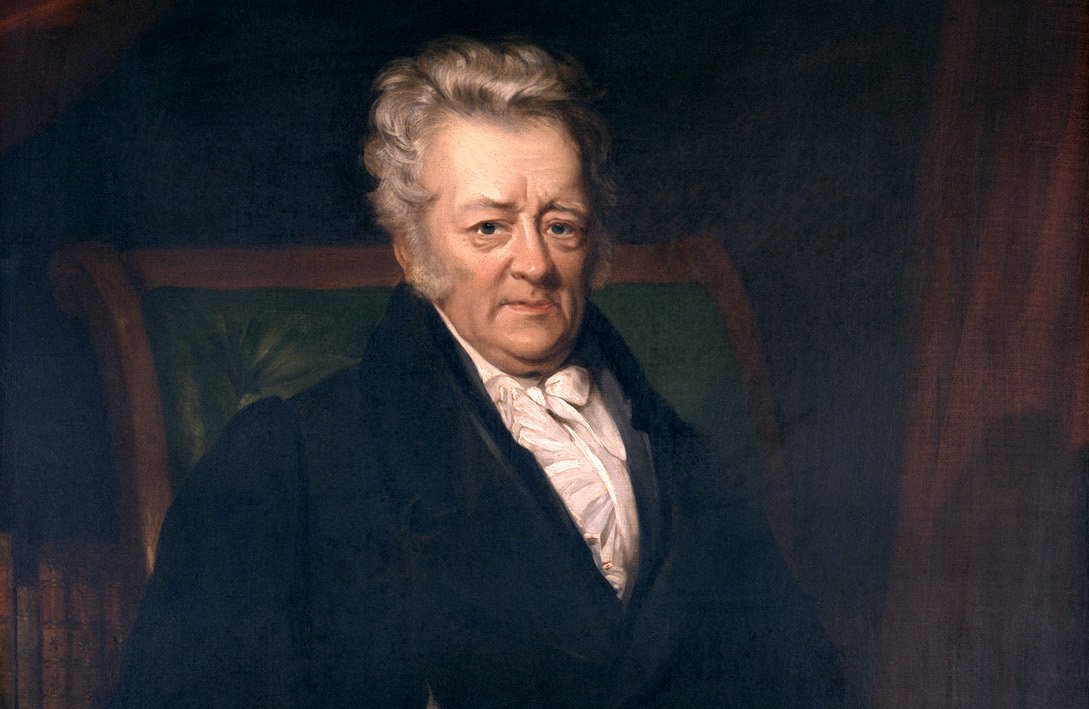
Thomas Clarkson
So he spent the next decade doing something almost unthinkable. More than 35,000 miles on horseback. Over 20,000 interviews with sailors off slave ships. Risking his life in port towns built entirely on that trade. He recruited a young member of Parliament named William Wilberforce, and together they brought bill after bill to abolish the slave trade before the British Parliament.
Every single year, the House of Lords voted it down.
Here's what I want you to notice. Clarkson already knew slavery was wrong. That was never his question. What he was actually doing, mile after mile, interview after interview, was trying to build up enough evidence that everyone else would finally see it too. He was trying to close the gap between what he already knew and what he could force the world to understand.
That is a great burden to carry: trying to master an enormous outcome that is beyond your ability to secure. It presses on your chest, and for Clarkson, it was quickly convincing him that his worth depended on getting this goal over the finish line.
When the Body gave up and Something Else did too
By the mid-1790s, Clarkson's body was failing, and without telling almost anyone, so was his faith.
His friends sent him away to recover in England's Lake District. He bought a small cottage there, mostly just to hide in.
What he didn't know was that at the other end of that same village lived a famous poet named Samuel Taylor Coleridge, who had admired Clarkson's work from a distance for years. When the two men finally met, Coleridge expected to find a hero. Instead he found a man completely hollow: a shell of his former self.
They didn't say much of this to each other in person. Being proper Englishmen, they wrote letters instead. In one of those letters, Clarkson finally told Coleridge the truth.
"I have no idea anymore of the Divine."
Sit with that a second before moving on. A man who had given a decade of his life to a cause he believed came from God had worked his way past believing God was even there.
Coleridge wrote back:
"My Dear Clarkson, don't worry now whether you have any idea of the Divine. But never forget that you are a Divine idea.”
Reaching the Edge of Reason
That quote has been ringing in my head for the past week. What does that even mean? Is it even true? What was Coleridge actually trying to say?
Here's what I find interesting. Coleridge doesn't argue Clarkson back into belief. He doesn't hand him a better proof for God or for the cause. He seems to understand that disappointment had stripped Clarkson of hope, that the things he'd once known to be true, he hadn't been able to bring to pass. Clarkson had reached the edge of a world he'd built with his own hands, and he could go no further.
If you and I had been the ones writing that letter, trying to comfort a friend who'd just confessed he had no idea anymore of the Divine, what would we have said?
I think that's why this quote reads so simply and lands so deep. Our thoughts matter. Our actions and beliefs matter. But the fact that we can think or act or believe anything at all is itself downstream of something else entirely: the thoughts of a timeless God. Not an impersonal universe that happened to produce us. A purposeful being who breathed life into dust, who spoke light into darkness. Yahweh, the great I Am, who was and is and always will be, and who thought each of us into being before time itself began.
Do we have a part to play? Absolutely. But I'll admit, as someone who's a bit type A, a bit of a go-getter, a firstborn who wants to have things figured out, I can get so caught up trying to find the right thoughts, trying to tweak and understand everything until I arrive somewhere solid, that I miss what's actually happening. God leads me, and you, and Thomas Clarkson, to the exact place where we can go no further.
That's where this story finds us. What you think about God, and where you are in your own story right now, matters. And still, it's small next to this: for every thought you've ever had about yourself, and let's be honest, most of ours are pretty hard on us, God has had far more thoughts about you than that.
A friend shared this with me recently, from Abraham Lincoln: "Take all of this book upon reason that you can and the balance upon faith, and you will live and die a happier and better man."
Essentially, you are allowed to take your rational mind and natural body as far as you can with God, but it will only go so far. Understanding the fullness of God is going to require you to get out of the boat that has oars and an engine and get into a sailboat that takes you beyond where you could ever go yourself. That's what faith is. That's what acknowledging the limitations of our own thoughts and humbly receiving God's thoughts even if we don't completely know or understand them.
Which is a nice idea until you're actually standing at the edge of your own understanding, staring at a life that doesn't look like what you hoped it would.
Look, God
And I think most of us bring God the same evidence over and over, holding it up like proof.
"Look, God! Do you see my life? I see nothing but failure and disappointment and betrayal and loss and heartache."
God sees something we can't see from where we're standing. Beauty rising out of brokenness. Life coming from death.
He's the artist who sees past the temporal shape of our human reasoning and experience, into something so much more beautiful it looks impossible from where we sit.
I don't think that's just a comforting idea. I think it's the actual shape of how He works. There's a song I kept thinking about while writing this, Rebecca St. James and for KING + COUNTRY's "You Make Everything Beautiful." It's the musical version of what I'm trying to say here: God takes what we hold up as failure and loss and makes something out of it we couldn't have seen coming.
Not a Subject to Master
I think a lot of our striving comes from this assumption that theology, the study of God, works the way biology or geology works. A subject. A field you study until you've mastered it, the way you'd take dominion over any other body of knowledge.
God isn't a subject. He's a person. And a person was never meant to be something you pass a test on.
We've tried to climb up to His height before. That's the whole story of Babel, people trying to build something tall enough to reach God's level, to understand on their own terms.
God isn't asking us to climb up to Him. He's asking us to trust that what He's thinking about us is better than anything we're thinking about ourselves.
Reflection: What would it mean for me to stop trying to figure God out today, and just let myself be known by Him instead?
The Thoughts That Are Higher Than Mine
I think this is exactly what Isaiah is getting at when God says:
"For my thoughts are not your thoughts, neither are your ways my ways, declares the Lord. For as the heavens are higher than the earth, so are my ways higher than your ways and my thoughts than your thoughts." — Isaiah 55:8-9
The Hebrew word there for "thoughts," machashabah, is the exact same word God uses two books later, in Jeremiah 29:11:
"For I know the plans I have for you, declares the Lord, plans to prosper you and not to harm you, plans to give you hope and a future." — Jeremiah 29:11
It’s the same word. A plan, built specifically for your good, that happens to be higher than anything you could have engineered on your own.
David writes something similar in one of my favorite psalms:
"How precious to me are your thoughts, God! How vast is the sum of them! Were I to count them, they would outnumber the grains of sand. When I awake, I am still with you." — Psalm 139:17-18

David calls that vastness precious. He doesn't need to count every one of God's thoughts to know they're good. And because he know’s God’s thoughts are good, he is that much more aware of God’s presence surrounding him.
Paul does the same thing at the end of Romans 11, after eleven carefully argued chapters on the richness of the Gospel:
"Oh, the depth of the riches of the wisdom and knowledge of God! How unsearchable his judgments, and his paths beyond tracing out!" — Romans 11:33
The word Paul uses for "beyond tracing out," aneksichniastos, only appears this one time in the New Testament. It doesn't mean hard to trace. It means there are no footprints to follow at all.
I cannot Think unless I have been Thought
I think this is what was actually happening in that cottage. Clarkson had spent a decade trying to trace a path, and he'd lost the trail. Coleridge stops him in his tracks. “Stop tracing”, he was saying. “Just receive.”
Centuries later, a poet found himself saying nearly the same thing.
Malcolm Guite tells this same story, and says it's part of what led him to write this sonnet, built around the ancient prayer "O Sapientia," Wisdom, come. I also thought it was beautiful and wanted to share.

I cannot think unless I have been thought,
Nor can I speak unless I have been spoken.
I cannot teach except as I am taught,
Or break the bread except as I am broken.
O Mind behind the mind through which I seek,
O Light within the light by which I see,
O Word beneath the words with which I speak,
O founding, unfound Wisdom, finding me,
O sounding Song whose depth is sounding me,
O Memory of time, reminding me,
My Ground of Being, always grounding me,
My Maker’s Bounding Line, defining me,
Come, hidden Wisdom, come with all you bring,
Come to me now, disguised as everything.
"O Sapientia" by Malcolm Guite
Thinking, speaking, teaching, breaking bread: none of the things we think we do are what make us valuable. We are valuable because God has already given himself to us, and everything we do is just that gift moving through us.
Unless You Become Like a Child
Jesus said something that stands in direct defiance of our understanding of maturity: unless we become like children, we can't enter the kingdom of heaven. Children don't master things. They receive them. Maybe the maturity I've been chasing was never supposed to look like complexity. Maybe it looks more like a kid who doesn't need to understand where dinner came from to sit down and eat it.
George MacDonald puts it beautifully:
"I would rather be what God chose to make me than the most glorious creature that I could think of; for to have been thought about, born in God's thought, and then made by God, is the dearest, grandest and most precious thing in all thinking." — George MacDonald
That's Ephesians 2:10, said simply:
"For we are God's masterpiece, created in Christ Jesus to do good works, which God prepared in advance for us to do." — Ephesians 2:10
And it echoes Paul's letter to the Romans
"For since the creation of the world God's invisible qualities, his eternal power and divine nature, have been clearly seen, being understood from what has been made." — Romans 1:20

Creation itself carries the fingerprints of a maker who thought it up before he made it. You're not an exception to that. You're the clearest example of it.
Paul makes the same point a different way in his letter to Corinth:
"But we have this treasure in jars of clay, to show that this all-surpassing power is from God and not from us." — 2 Corinthians 4:7
The container was never supposed to be the source of power. That's true of clay jars, and it was true of us. We hold the treasure of Christ in us, and he uses our frailty to proclaim His glory!
The works were already prepared, waiting long before we ever showed up to do them.
Put the Pen Down
If you're in the place Clarkson was in, trying to force outcomes or write your autobiography ahead of time.
Put the pen down. Let yourself be written instead.
Maybe the maturity we've been chasing was never about better answers or sharper theology. Maybe it's just about knowing the Father.
Surrender your own sense of what's important. Surrender what you think you know. Let yourself be thought about.
References
Malcolm Guite, "O Sapientia," from Sounding the Seasons: Seventeen Sonnets for the Christian Year (Canterbury Press)
Malcolm Guite, interview on "Pints With Aquinas," where he recounts the Clarkson-Coleridge exchange
The Coleridge-Clarkson correspondence is referenced in The Collected Letters of Samuel Taylor Coleridge, ed. Earl Leslie Griggs, Vol. II (Oxford: Clarendon Press). This account follows Guite's retelling rather than a directly verified primary source.
If this resonated with you, I’d love to hear about it and even have a conversation!
Learning to Become Who We Already Are In Him,
John Will
