
The Weight of the Ideal Self
The Self That Lives in Your Head
There is a version of me that lives in my head.
He wakes up early.
He journals and works out every day.
He maintains all of his family and friendship relationships at a deep level.
He reads five books every day, slowly and thoughtfully, without distraction, to completion.
He never misses a quiet time with God every morning.
He never falls short of any goal he sets for himself.
He always lives with complete clarity, purpose, and serenity.
He is able to draw out all the juice that life has to offer.
He lives constantly with the ability to handle whatever obstacles life or God may throw his way.
I love this version of me. I want him. I believe I could be him.
And yet, he has never lived inside my actual life, at least not for more than a few moments.
Especially in the last few weeks, as I have faced one obstacle after another, carrying weights on my metaphorical shoulders that start to feel like actual weights, I begin to think of him—my ideal self. He would be able to handle all of this. Why can’t I be more like him?
The gap between my ideal self and me feels like trying to jump over the Grand Canyon. I feel so far behind, and the compounded exhaustion and sense of failure can start to feel overwhelming.

The Ideal Self Is Often a Disguised Fear
The more I chased him, the more I realized something about the ideal self: he is a disguised fear.
Beneath the surface, he whispers:
“If I can control my habits, no one will ever be disappointed in me.”
“If I keep pushing to be impressive, then I will be safe.”
“If I’m disciplined enough, I won’t ever have to rely on mercy or grace.”
“If I’m spiritual enough, God won’t be disappointed in me.”
I remember journaling and lamenting last week about all the things I should have done better. My heart raced and my chest ached.
I am starting to see that my chasing of these idealistic goals was really chasing safety, acceptance, and self-worth.
The ideal self isn’t just who I want to be. Sometimes I feel I must be him if I am to survive at all. That is one reason he holds so much power: he is holding my deepest fears hostage.
The Ideal Self Is Often Built in the Shadow of Shame
The ideal self not only preys on my fears but also preys on my shame.
Shame whispers, “The real you is not enough. You must become someone else to be worthy of love.”
And like a hostage negotiator, I try to bargain with God through life: “If I become this person, maybe I’ll finally be enough.”
But then I remembered David.
David was the man after God’s own heart, and yet he knew what it was to fall short, to be messy, to carry the weight of guilt and failure, and still be seen and shaped by God. After his failures, he prayed,
“You desire truth in the inward being ”
Not perfection. Not performance. Not the version he wished he had been. Just reality. Just truth. That was all God wanted.
David’s transformation didn’t begin when he became the best version of himself. It began when he became the most honest version—when he brought truth before God and started to counsel his own soul.
You and I are flawed, yes. We are tired and often longing. Yet we are seen. God wants to meet us, and he only wants the real us—not the fantasies we give him or the ones we project to others.
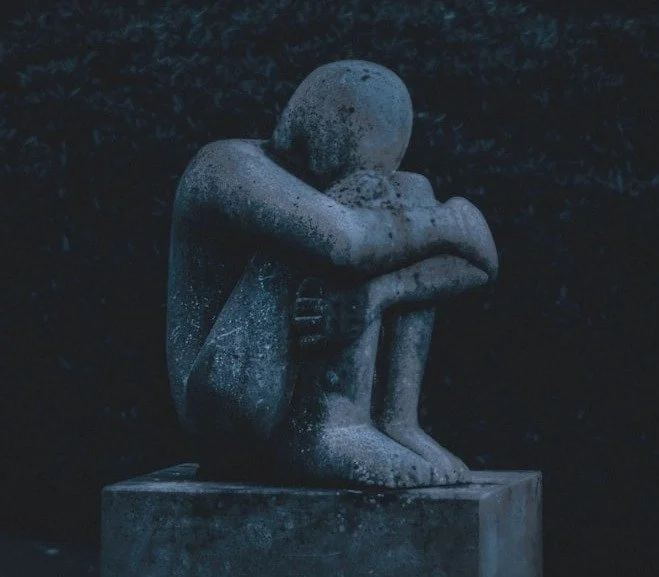
The Ideal Self Is a False Timeline
Underneath the pressure to become my ideal self was another trap: the false timeline.
“I should be further along by now.”
Where does that expectation come from? It doesn’t come from God or Scripture. It comes from our constant pull toward comparison, whether what we are observing is reality or fantasy. It comes from cultural speeds that tell us where we should be. It comes from our internalized perfectionism that tries to control and avoid chaos. It comes from the fear that we’ve wasted time. It comes from the ache of longings that haven’t been realized yet.
We often notice this in the dry seasons of isolation. We scroll past a friend’s post or read about another’s achievements and feel that familiar pinch in our chest. But are we actually racing against reality or against a phantom?
God’s timelines are often so different from ours. He is far more patient and slow than we ever want him to be. And yet all of creation points to his preferred pattern of formation. He grows us through seasons, not speed. We are trees in God’s garden, unfolding slowly in His appointed time, not machines racing toward the next task
The Ideal Self Ignores the Body
I also realized that my ideal self ignores the body.
The shame I felt about not becoming him wasn’t just spiritual or emotional. Part of it was biological. My nervous system gets overloaded. My cortisol stays high. My emotional bandwidth shrinks. My body remembers my pain, even when my mind tries to move on.
The ideal self does not have a body. He does not get dysregulated. He does not feel fatigue. He does not grieve.
I do. And God does not shame bodies. My limits are not moral failures. They are part of God’s design.

He knows our frame and remembers that we are dust. He gave us bodies meant to be listened to, not ignored. Even on days when my shoulders ache, my jaw is tired, or my heart feels heavy, God will meet me there. He does not demand more. He is simply present, tending the hidden garden of my soul and body, bringing warmth and care to what feels frozen and fragile.
The Ideal Self is a Counterfeit of Sanctification
Here is another irony. The ideal self that often seems so spiritual is actually a counterfeit of sanctification.
He says, “Become holy, and then you will be loved.”
God says, “You are deeply loved. Now walk with Me and I will shape you.”The ideal self produces pressure. The Spirit produces fruit.
Real growth is slower, gentler, and relational. It happens only by abiding in the life of Christ. Real growth comes through faith. The ideal self requires no faith.
This transformation unfolds in the middle of your real life, not in the fantasy of what your life could look like if you were perfect. It may appear in the most ordinary moments, but God is always shaping us quietly, gently, and relationally in ways the ideal self never could.
The Ideal Self Does Not Know Your Calling
The person in my head is not necessarily the person God is forming me to be.
I might imagine myself as a scholar, a disciplined monk, a serene contemplative, a fitness warrior, or a productivity master.
But have I ever asked God what he wants me to be?
God may be shaping in me something very different. Often he is far more concerned with the quality of the person I am becoming, one who is full of compassion, patience, endurance, presence, humility, and faithfulness.
The ideal self and God’s formed self are not always the same. Chasing the one in my head will leave me exhausted and frustrated if it is my own creation and not God’s. Following the one God is forming allows me to grow in truth and in life.
The Ideal Self Cannot Hold Your Humanity, But God Can
The deepest truth is this. The ideal self cannot hold my humanity.
He cannot love me. He cannot forgive me. He cannot meet me in my exhaustion or my failure.
God can and already does.
The ideal self offers conditional acceptance, relentless pressure, constant self-evaluation, and a future where I might be okay someday.

God offers presence, compassion, a new heart, formation in the reality of my life, and belonging here and now.
The ideal self says, “Try harder.”
God says, “Come to Me.”
The Honest Version of You
I don’t need to be the perfect version of myself to start growing.
I only need to be the honest version of myself.
In that place of honesty, messiness, fatigue, and incompletion, I find God waiting patiently, shaping me from reality, not from imagination.
My soul is like a small garden in the middle of winter. The shoots lie buried under frost, fragile and almost invisible, yet life is still stirring beneath the frozen soil. God tends the garden in my reality, not in my imagined perfection. He brings warmth, water, and sunlight to the places I cannot reach, and slowly, quietly, the first green begins to show.

This is where true change begins. This is where I stop striving to be the ideal self and start becoming the person God is shaping me to be.
