Jesus, I Want Life
Why my soul still thirsts
Jesus, I want life—life to the full, life of abundance, variety, purpose, vision, peace, joy, vibrancy.
There is a physical life that I am obviously experiencing in this moment. My head agrees with your words—that my spirit is one with your Spirit, that it is alive and well, seated with you in heavenly places—and yet, most moments there seems to be a chasm.
My body is physically alive, but my mind, will, and emotions—my soul—seem to teeter. They are easily thrown off course. My soul is still thirsty. My soul is searching for more life. My soul is searching for the life that my spirit says it has.
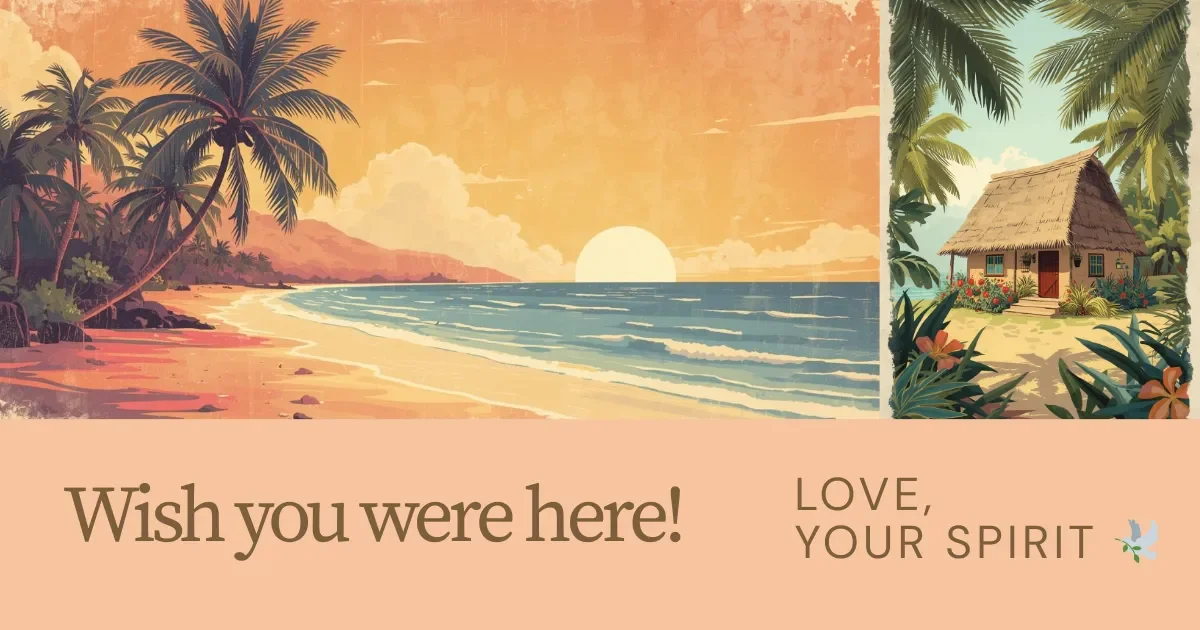
I do believe that, and yet it feels the same as getting a tropical postcard from a dear friend: Wish you were here.
When Thirst Turns into Shame
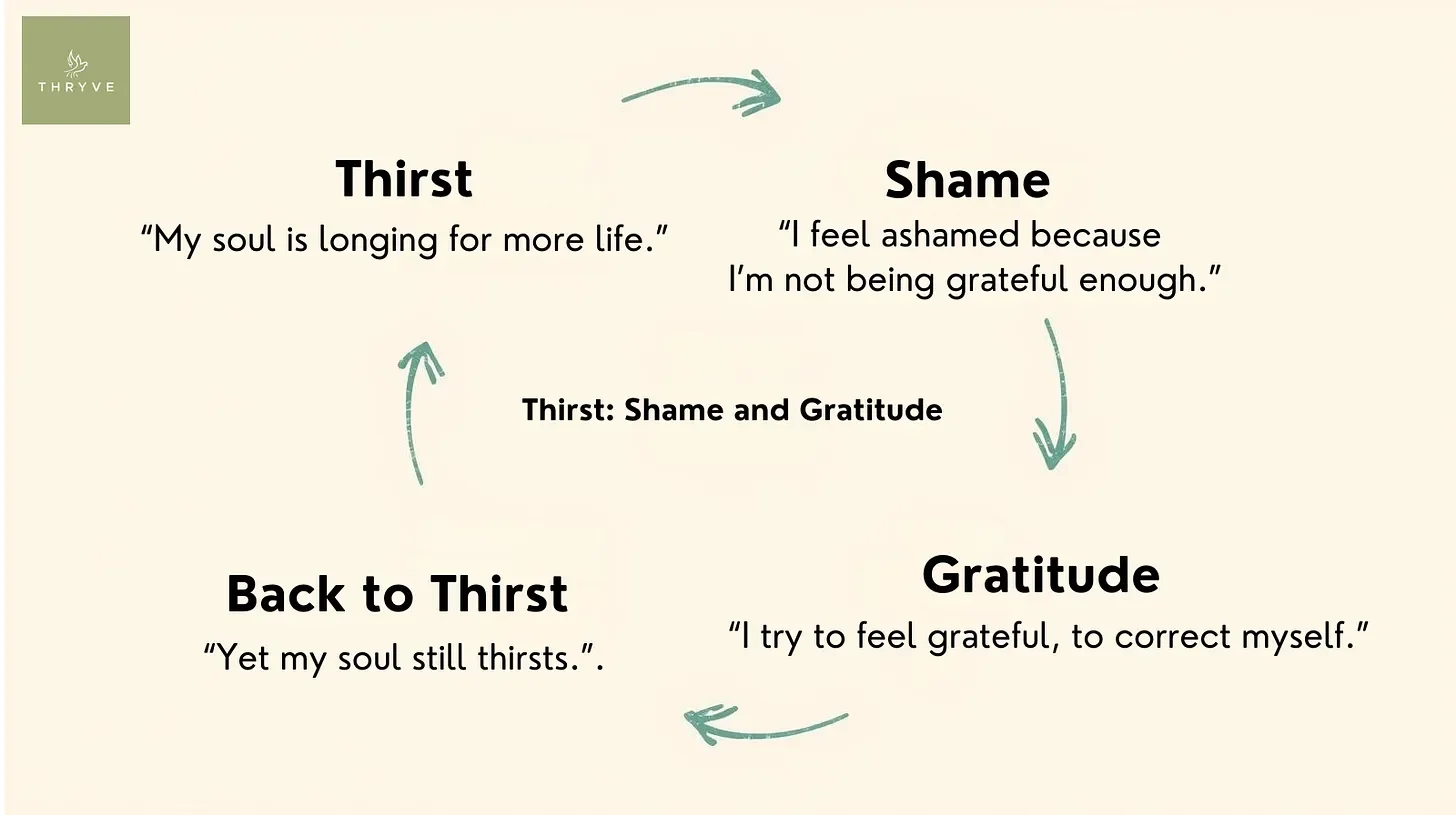
Even when I intellectually believe my spirit is alive in God, my soul struggles. That struggle often takes the shape of a strange paradox—where my thirst for life collides with shame over not being grateful enough.
Your words tell us to rejoice always, give thanks in all circumstances, count it all joy.
Yes, there truly is so much to thank you for that I fail to do most of the time. I have been blessed with so many physical and relational blessings that I get to simply and freely enjoy, even though I do nothing to earn or deserve them.
I have a lovely wife, house, job, family, and enough hobbies and relationships where, if I were reading the life of someone else on paper, I’d be saying, What do you have to complain about?
So many, in fact, literally 99% of people living have it worse off than you do—and yet my soul is still thirsty.
Because I experience the thirst, I tend to label that as, Well, you’re just not being grateful enough. What is wrong with you?
This wide-eyed, mystical, romantic, rose-colored desire for more life feels totally out of place. It has no space to rest its head, and so that thirst for life becomes an endless shame cycle: thirst, be more grateful, try to be more grateful, inevitable thirst, more shame leads to more thirst.
Where We Go Looking for Life
What our cultural moment offers us has not satisfied mine—or anyone’s—thirst.
What I observe is that most people are either:
Thirsty
Or too numb to admit they are thirsty
More money, nicer cars or houses, designer clothes, cooler friends, luxury trips, Michelin-star restaurants, the latest technology—even the newest water bottle, iPhone, or lifestyle hack.
Even versions of life that go against the grain are trying to create life: coffee shops, analog watches, leather journals, fountain pens, organic non-toxic foods and products, wide-toe-box shoes, retro hats, grandmother sweatshirts—and I love lots of these myself.
Many of us are searching for an embodied alternative to our consumeristic digital age, which I would agree is probably a net positive. Chances are that if you have less microplastics, less processed food, less blue light, and more barefoot grounding, more sunlight, more whole foods, and more tech-free sleeping, you will likely have a better experience of life.
And yet, there is a subtle narrative about the promise of life that we need to be made aware of.
Many of these against-the-grain archetypes are trying to harken back to some period of past history in the hope that there was life back there—and if we make enough changes to our lifestyle to replicate, or at least make a hybrid version of that time period, then maybe we’ll find a bit more life.
The TV show Stranger Things has done this brilliantly by becoming a parable for the yearnings and struggles of this generation—a harkening for nostalgia of a time never known. Stranger Things works because it taps into something ancient. A belief that life used to exist somewhere else. Somewhere behind us. Somewhere we missed.

So we reach backward.
The Roaring 20s.
Woodstock.
80s metalheads.
Victorian England.
90s rom-coms.
The 1940s Greatest Generation.
Cowboys and Western settlers.
Native Americans.
Knights of the Round Table.
Braveheart.
The Greek, Egyptian, and Roman Empires.
In one form or another, most people, including myself, seem to be trying to recover life by taking pieces of life from the past to make our present more enjoyable and our future more hopeful.
It is ironic how, for all the talk of how forward and progressive we are in the present, we all seem to be reaching for life in the past—whether our own past or the lives of our ancestors.
Even the extreme right-wing and left-wing calls for redefinition of humanity and purpose—whether it be gender, sexuality, economic policy, or technology and AI—are actually just new words and phrases for ideas that have been around for almost as long as humanity.
Our cultural moment is eerily similar to different people groups in the book of Genesis: Sodom and Gomorrah, the time of Noah and the global flood, the Tower of Babel. All people trying to define life, accumulate life, and become a god.
There really is nothing new under the sun.
And if we were to dive deeper into any of these past cultures, we would find them all to be the same as ours—mixed at best. Sure, some things might be better, and yet other parts are worse. There is still poverty, war, sickness, greed, corruption, sexual degeneracy, addictions, abuse.
If we have awareness, most of us wouldn’t say the current nature of the world is positive, even if we have a plethora of ideas for how we might solve it. But is there any hope to be found in a past filled with so many mixed results?
In a way, yes.
When Life Was Whole
If we go back just a little further in history, there is one period of history that was truly bursting at the seams with life. The Garden of Eden was that place. People with bodies, souls, and spirits all bursting with life. No evil. No disappointment. No depression. No disillusionment. Truly nothing lacking. No soul was thirsting. All was very good.
But what made the garden so mystical and magical?
Yes, there was no sin. That’s what we’re taught, and that is true. But we say that primarily because we’re so accustomed to sin as our default. We tend to measure good things by them lacking or not lacking bad things. Family dinner was good because there was no conflict. The weather is beautiful because there are no rain clouds.
We’re accustomed to the lack and death that sin brings to life, that we forget what life truly is and was meant to be.
The garden was truly good because life was truly there.
But that life was not a mystical Star Wars force floating around like a stray balloon. That life had a name. God was that life.
The great I Am, who exists outside of all time, space, and matter, took his pen and with simple words spoke life into existence.
C.S. Lewis, in The Magician’s Nephew, harkens back to this moment in his description of how Narnia came to be. Every tree, plant, mountain, and animal comes from the song of the lion Aslan. The world of Narnia is bursting with life because of the song—so much so that an iron bar thrown by the witch at Aslan falls to the ground and then magically grows into the famous lamppost.
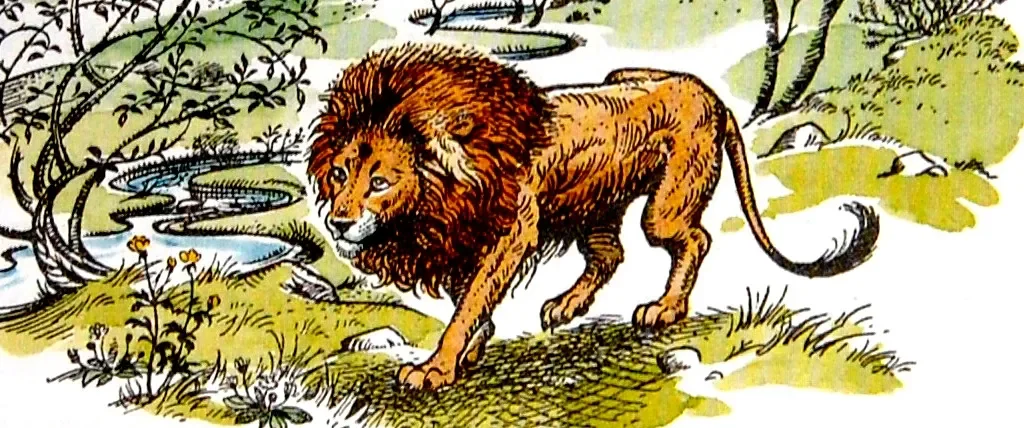
The humans observing the creation of Narnia—Polly, Diggory, and Uncle Andrew—of them only the two children are able to hear the beautiful song. They’re the only ones experiencing life. The evil Uncle Andrew only hears roaring, which he hates.
Aslan himself says it best:
“This world is bursting with life for those few days because the song with which I called it into life still hangs in the air and rumbles in the ground. It will not be so for long. But I cannot tell that to this old sinner, and I cannot comfort him either. He has made himself unable to hear my voice.” (Lewis, 1955, p. 121).
What Died in Eden?
Reading this, I can’t help but wonder. If life once filled the world like music in the air, then why does it feel so hard to hear now? If the garden was alive in this way, then something must have happened to our ability to receive it.
In the garden, there was a Tree of Life. God told Adam that if he ate from the Tree of the Knowledge of Good and Evil, he would surely die.
Adam ate.
So what died?
Not his body. Not right away.
He kept breathing.
He kept working the ground.
He kept having children.
The story keeps moving, which tells me something else must have happened.
Something quieter.
Something deeper.
His spirit.
And once spiritual life was severed, everything else began to unravel. What dies in the spirit eventually shows up in the soul, and what withers in the soul eventually reaches the body. Death works its way outward.
In Adam, humanity begins spiritually dead, slowly moving toward physical death.
But in Christ, the movement reverses.
If we are in Christ, we are spiritually alive. I believe that to be true regardless of what I feel. And still, my lived experience often feels backwards. My body feels solid and immediate. My soul feels unstable, thirsty, easily thrown off course. And spiritual life, though real and present, can feel far away. Like a place I know exists, but have not yet learned how to live in.
Three Kinds of Life
This is where the Greek words for “life” help make sense of what I’m feeling.
Bios (𝛽𝜄́𝑜𝜍) is physical life—biological existence. Breathing, eating, working, aging, dying.
Psuchē (ψυχή) is soul life—the mind, will, emotions, personality, desires. This is where anxiety, longing, shame, and thirst live.
Zoē (ζωή) is spiritual or divine life—the eternal life of God himself. Not merely life that lasts forever, but life of a different quality, God’s own life.
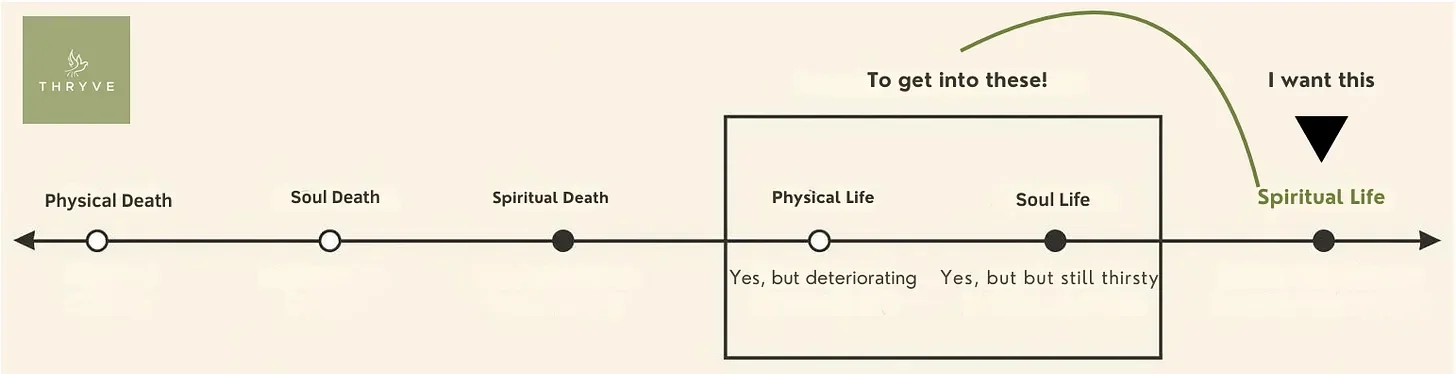
In Eden, Adam had all three in harmony. Bios, psuchē, and zoē were integrated and overflowing.
After the fall, humanity kept bios, slowly lost psuchē, and became cut off from zoē.
In Christ, we are given zoē again. But the tension I live in is this: Zoē is true of me, but psuchē often hasn’t caught up yet. My soul remains thirsty—not because something is wrong with me, but because my soul has not yet learned how to drink.
Life has a face
Life was never meant to be this abstract painting. It was always meant to be personal.
Life has a face.
Life originates in the Father, flows through the Son, and is sustained by the Spirit. This is not abstract—it is the very power that sustains everything that breathes.
The Father is life
The Father has life in Himself. Life does not begin with creation. It begins in God. He is not dependent on anything outside Himself to live, and yet He delights to give life. The One who raised the dead then, still gives life now.
John 5:26: “For as the Father has life in himself, so he has granted the Son also to have life in himself.”
John 5:21: “For just as the Father raises the dead and gives them life, even so the Son gives life to whom he is pleased to give it.”
The Son is life
The Son is life. Jesus does not merely point the way to life or distribute it from a distance. He is life. To know Him is to have life, and to be cut off from Him is to be cut off from life itself. Every light, every breath, every pulse of vitality finds its source in Him.
1 John 5:11–12: “And this is the testimony: God has given us eternal life, and this life is in his Son. Whoever has the Son has life, whoever does not have the Son does not have life.”
John 14:6: “I am the way and the truth and the life.”
The Spirit is life
The Spirit is life. He is the breath of God that animates what would otherwise remain lifeless. He gives life where flesh cannot. He sustains what we cannot sustain on our own. Where the Spirit dwells, life is present, active, and growing.
Job 33:4: “The Spirit of God has made me; the breath of the Almighty gives me life.”
John 6:63: “The Spirit gives life; the flesh counts for nothing. The words I have spoken to you—they are full of the Spirit and life.”
Romans 8:10: “But if Christ is in you, though your body is subject to death because of sin, the Spirit gives life because of righteousness.”
This is why life cannot be reduced to technique, discipline, or self-improvement. Life is not something we generate. It is Someone we receive.
The Trinity is life. Father, Son, and Spirit together are the source of all that lives, all that endures, all that satisfies the deep longings of the heart.
Life is not merely a gift God hands to us and steps back from. It is the very nature of God flowing into us. It is what my soul thirsts for, what my body enjoys, what my mind reaches for, what my spirit already knows.
All of life, in its fullness, finds its source in Him.
Come and Drink
The life that my soul craves—what it thirsts for—is to know God. Not to intellectually assent to Him, but to know Him. To be united to Him. To experience Him in all His fiery goodness.
My soul yearns for fathering
My soul yearns for purpose and meaning
My soul yearns to be intimately connected
My soul yearns for true beauty, goodness, and delight
My soul is yearning for life to the fullest
My soul is yearning for God
Yes, I know that He is with me and in me. Yes I feel much like David:
Psalm 42:1–2: “As a deer pants for the water so my soul longs for you. My soul thirsts for God, for the living God. When can I go and meet with God?”
Psalm 63:1: “You God, are my God, earnestly I seek you, I thirst for you, my whole being longs for you in a dry and parched land where there is no water.”
Like David, I seem to thirst more every day I live in this world.
And what is Jesus’ response to our thirst? It is simply, “Come.”
This is a grand but simple invitation.
Isaiah 55:1: “Come, everyone who thirsts, come to the waters; and he who has no money, come, buy and eat! Come, buy wine and milk without money and without price.”
John 4:14: “Whoever drinks of the water that I will give him will never be thirsty again. The water that I will give him will become in him a spring of water welling up to eternal life.”
John 7:37: “If anyone thirsts, let him come to me and drink.”
Revelation 22:17: “The Spirit and the Bride say, ‘Come.’ And let the one who hears say, ‘Come.’ And let the one who is thirsty come; let the one who desires take the water of life without price.”
This is a grand but simple invitation:
You who are thirsty.
You who want life.
Come to me and drink.
My instinct—even in this moment—is to say, “Yes, but then what?”
But I think I miss the point.
Come and drink first.
Leave the rest to Him.
I don’t need to do anything.
Come and drink first.
Let the life of God meet you there.
Let zoē quietly make its way into psuchē.
Let the soul slowly steady as it learns to receive.
And let even our ordinary, physical bios lives become animated by His life.
Just come, drink, and have my fill of God.
Learning to Become Who We Already Are In Him,
John Will